

Gas Visualization
Gas visualization or Optical Gas Imaging (OGI) is the science of imaging gases. There are several techniques for visualizing a gas including the use of a thermal camera.
To visualize a gas with a thermal imaging camera, it is important that the gas absorb light in the spectral band in which the camera is built. But most gases are not visible with a standard thermal imaging camera. So to map gases, it is better to use a gas visualization camera.
Find out on this page which gases you can image with a gas detection camera:
Explore our range of gas detection cameras below:
Fluorocarbons
Hydrofluorocarbons (HFCs), or hydrofluorocarbons, are a group of chemical compounds containing carbon, hydrogen and fluorine. These substances are often used as refrigerants in air conditioning systems, refrigerators and other applications requiring refrigeration technology. They are also used in other industrial applications such as solvents, fire extinguishing agents and as propellants in aerosols.
What are common fluorocarbons?
- R-134a: A commonly used refrigerant in air conditioners and refrigerators.
- R-410A: A mixture of HFCs (R-32 and R-125) and is widely used in air conditioning systems.
- R-32: A refrigerant that has less potential to warm the climate than some other HFCs, but still contributes to warming.

How can we visualize these gases with a gas detection camera?
- Infrared absorption: Fluorocarbons absorb infrared radiation at specific wavelengths. The gas visualization camera is equipped with an infrared detector that can measure the absorption of these wavelengths. Because each gas has a unique absorption profile, the camera can detect the gas and display its location.
- Spectroscopic recognition: The camera uses a gas sensor that specifically tunes to the wavelengths of the gases you want to detect. HFCs (such as R-134a, R-410A, etc.) have specific peaks in their absorption spectrum that allow them to be effectively detected by the camera.
- Visualization: The camera takes an image of the area where the gas becomes visible, often as a colored cloud or spot. The closer you get to the leak, the more intense the color will be (usually in blue or green, depending on camera settings), indicating that the gas concentration level is higher. The image helps locate the leak, even in hard-to-reach places.

- Real-time measurements: Gas Visualization Cameras provide real-time images so you can quickly see where the gas is and how much of it is present. This is useful for inspections in air conditioning systems, refrigerators or refrigeration plants where hydrofluorocarbons are often used as refrigerants, for example.
FLIR has launched the FLIR G304 refrigerated camera to image hazardous and environmentally damaging refrigerant gases from a safe distance. So you don't have to interrupt or shut down systems to take measurements. The gases you can measure with this camera are hydrofluorocarbons, refrigerant gases and other industrial gases.
Sulfur hexafluoride (SF6)
Sulfur hexafluoride (SF₆) is an odorless, colorless and non-flammable gas used as an insulator in electrical equipment such as in transformers, switchgear and electrical switches. It is also used in some scientific applications and as an agent in magnesium production. SF₆ has a number of advantages, including excellent insulating properties, but it also has a very high greenhouse gas effect and contributes to global warming when it enters the atmosphere. This makes it important to carefully monitor its use and potential leaks.
You can use a gas detection camera to detect SF₆ and other gases. This type of camera works by measuring infrared radiation absorbed by specific molecules. SF₆ has a characteristic absorption in the infrared wavelength range, which makes it possible to detect the gas. Detecting sulfur hexafluoride with a camera has numerous advantages, such as real-time monitoring, it is a non-invasive inspection method and leaks are quickly located.

How can you detect sulfur hexafluoride with a gas detection camera?
- Infrared detection: Gas detection cameras using infrared (IR) spectroscopy can detect the specific wavelengths of infrared radiation absorbed by sulfur hexafluoride. Each gas has its own unique absorption spectrum, and SF₆ absorbs strongly in certain parts of the infrared spectrum.
- Temperature and concentration measurements: Cameras can measure the variation in temperature and the amount of gas (i.e., concentration) based on the radiation absorbed. The result is often displayed as a visual image where the gas is visible through different color levels indicating the concentration of the gas.
- Detection of leaks: Gas detection cameras can visually identify SF₆ leaks in air by showing the temperature differences created by gas leaks. The gas often becomes visible as a "spot" or "cloud" on the camera's screen with the color intensity indicating how much gas is present.
The FLIR G306 refrigerated gas detection camera is specially designed to detect sulfur hexafluoride (SF6), ammonia (NH3), ethylene (C2H4) and other industrial gases can be mapped from a safe distance.
Carbon dioxide (CO2)
Carbon dioxide (CO₂) is a colorless and odorless gas that is naturally present in the atmosphere and plays an important role in the greenhouse effect. It is produced by various processes such as respiration of living organisms, combustion of fossil fuels (such as natural gas, oil and coal) and decomposition of organic matter. Carbon dioxide is also a product of many industrial processes, such as cement production, and is often used in the food industry for packaging and as a refrigerant (liquid CO₂).

How does the gas detection camera detect the gas CO2?
- Infrared absorption: Carbon dioxide absorbs infrared radiation at a specific wavelength. The gas detection camera uses an infrared sensor to observe this absorption. This means that when CO₂ is present, the infrared light is absorbed. The camera can detect this change and convert it into a visual image.
- Principles of detection: Most gas detection cameras that detect CO₂ use non-dispersive infrared spectrometry (NDIR). This is a technology that passes infrared radiation through a sample of air and detects how much radiation is absorbed by the molecules of the gas (such as CO₂). The more radiation is absorbed, the more CO₂ is present in the air.
- Visualization: The camera takes a visual image of the environment showing the gas concentration. This is usually visualized by color coding. For example, areas with higher concentrations of CO₂ may be highlighted in blue or green, depending on the camera settings. This helps to quickly identify leaks or areas with elevated concentrations.
- Detection of leaks: Gas detection cameras can help detect gas leaks in applications such as industrial processes, CO₂ storage areas (such as in the food industry) and systems that use CO₂ in the environment. If CO₂ leaks from a system, the camera will visualize the elevated concentration.
- Real-time monitoring: Gas detection cameras provide real-time monitoring so you can immediately see where the concentration of CO₂ in the air is too high. This is especially important in confined spaces such as basements, laboratories or industrial facilities where elevated CO₂ concentrations can be hazardous to health.
The innovative FLIR G343 is a refrigerated gas visualization camera that allows you to measure CO2 can visualize leaks from a safe distance.
Carbon monoxide (CO)
Carbon monoxide (CO) is an odorless, colorless and highly toxic gas produced by the incomplete combustion of carbon-based fuels such as wood, natural gas, oil, coal and gasoline. It is often produced by malfunctioning appliances such as stoves, geysers, heating systems and engines. Because CO is odorless and colorless, it can be difficult to detect without proper equipment, making it dangerous to people exposed to high concentrations.
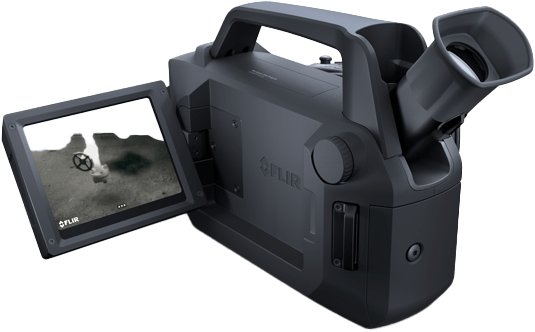
Although carbon monoxide is odorless and colorless, some gas detection cameras with infrared technology can be used to visually visualize the presence of CO in the air. Gas visualization cameras work by using the infrared absorption properties of gases to detect them.
How can you detect CO with a gas detection camera?
- Infrared absorption: Carbon monoxide has a specific absorption profile in the infrared spectrum. When a gas such as CO is present, it absorbs infrared light at a specific wavelength. The gas visualization camera is equipped with infrared sensors that can detect these specific wavelengths and translate them into a visual display.
- Spectroscopic detection: Most gas visualization cameras use Non-Dispersive Infrared Spectroscopy (NDIR) to detect gases. In NDIR, light is passed through a gas sample and the camera measures how much of that light is absorbed by the gas. Carbon monoxide absorbs light at specific wavelengths, which means the camera can detect the presence and concentration of CO.
- Visualization of CO leaks: The camera shows the presence of carbon monoxide as a visual image, often color-coded to indicate the concentration. CO leaks may be shown as a colored spot or cloud on the camera screen, depending on the concentration of the gas. The stronger the color, the higher the concentration of the gas in that area. This helps in locating leaks and identifying areas of risk such as with appliances that use fuels (for example, furnaces or heaters).

- Real-time monitoring: Gas Visualization Cameras provide real-time visualization, meaning you can immediately see where CO is located and how strong the concentration is. This makes it easier to take quick actions and avoid dangerous situations, especially in enclosed spaces where carbon monoxide can accumulate quickly.
FLIR designed the G346 cooled gas detection camera to image the following gases: carbon monoxide (CO), nitrous oxide (N2O) and other hazardous gases.
Hydrocarbons
Hydrocarbons (KWs) are organic compounds composed exclusively of carbon (C) and hydrogen (H) atoms. They form a broad group of substances found both in nature and in industrially produced products. Hydrocarbons are often divided into aliphatic hydrocarbons (straight-line or branched chains) and aromatic hydrocarbons (molecules with a ring structure).
KWs are widely used in industry, for example, as fuels (gasoline, diesel, natural gas), raw materials for the chemical industry (for example, in the production of plastics, synthetics and solvents) and as raw materials for products such as cosmetics, paints and detergents.
What types of hydrocarbons are there?
- Alkanes: These are saturated hydrocarbons such as methane (CH₄), ethane (C₂H₆) and propane (C₃H₈).
- Alken: These are unsaturated hydrocarbons such as ethylene (C₂H₄) and propylene (C₃H₆).
- Alkynes: These are unsaturated hydrocarbons such as ethyn (C₂H₂) and propane (C₃H₄).
- Aromatic hydrocarbons: These are KWs with a ring structure of carbon atoms such as benzene (C₆H₆) and toluene (C₇H₈).

How are these gases visualized with a gas detection camera?
- Infrared absorption: Hydrocarbons, such as methane or benzene, absorb infrared radiation at specific wavelengths. Each type of gas has its own unique absorption pattern. Gas detection cameras are often equipped with non-dispersive infrared spectrometry (NDIR) technology. This technology detects the wavelengths absorbed by hydrocarbons. The infrared light absorbed by the gas molecules indicates how much of the gas is present.
- Spectroscopy: Gas detection cameras use spectroscopy to determine the amount of gas in the air. The camera captures infrared light absorbed by hydrocarbons and the data is then converted into a visual image. The camera indicates where the concentrations of hydrocarbons are highest, usually using color coding.
- Visualization of gas leaks: Gas detection cameras can make KWs visible through color differences in the air caused by elevated concentrations of gas. The camera shows the presence of hydrocarbons as a colored cloud or spot, with the intensity of the color indicating the concentration of the gas. This makes it possible to quickly locate where a leak is located, such as in a gas pipeline, gas station or at storage facilities.
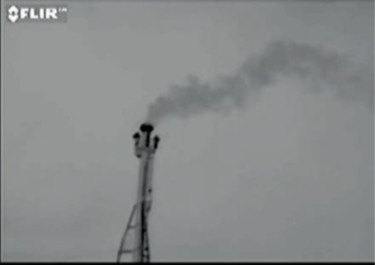
- Real-time monitoring: Gas visualization cameras provide real-time visual feedback of gas concentrations. This is particularly useful for quickly identifying leaks and taking action to prevent hazards such as fires or explosions.
The FLIR G620, the FLIR Gx320 and the FLIR Gx620 refrigerated cameras detect hazardous gases such as hydrocarbons, methane and other volatile organic compounds (VOCs). The FLIR Gx320 and the FLIR Gx620 cameras are also ATEX certified.
Methane
Methane (CH₄) is a colorless, odorless and flammable gas that occurs naturally in the atmosphere and is a major component of natural gas. Methane is one of the major greenhouse gases and contributes to climate change. It is produced by biodegradation of organic matter, for example in swamps, landfills, livestock farming and as a byproduct of fossil fuels.
Methane is not toxic, but it is highly flammable. It is used as a fuel in industry, households (through natural gas) and as a feedstock for the chemical industry. It is important to detect methane leaks quickly because it can be explosive in high concentrations and has a significant effect on the greenhouse effect.
Methane is also released during fossil fuel extraction and is a major concern in the oil and gas industry. It can also escape through gas leaks in pipes and equipment, which can cause safety hazards.

How can you detect methane with a fixed gas detection camera?
- Infrared absorption: Methane absorbs infrared radiation at a specific wavelength. Gas detection cameras use infrared spectroscopy to detect this wavelength and measure the presence of methane in the air.
- Non-dispersive infrared spectroscopy (NDIR): Most gas detection cameras that can detect methane use NDIR technology. NDIR measures the absorption of infrared radiation by the gas. The more methane present, the more infrared light is absorbed. The camera collects data on the amount of light absorbed and uses that information to calculate and visualize the concentration of methane in the air.

- Visualization of methane: When the camera detects an increased concentration of methane, it is displayed as a visual image. This can be a colored cloud or spot, depending on the camera settings. The greater the concentration of methane, the more intense the color.
- Real-time detection and monitoring: Gas detection cameras provide real-time monitoring so you can immediately see where methane is accumulating. This is essential for quickly identifying methane leaks in areas such as gas pipelines, storage facilities, drilling rigs or livestock environments.
FLIR has launched a fixed, uncooled, autonomous leak detection camera designed specifically for methane gas visualization. This is the FLIR GF77a camera that allows you to detect methane (CH4), nitrous oxide (N2O), propane (C3H8), sulfur dioxide (SO2), R-134a and R-152a can be imaged.